

Why Invest in an Ergonomic Office Chair?
Why Do We Invest in Cars and Beds, but Forget About the Office Chair?
When choosing a new car, we can spend weeks comparing different models. We look at the seats, suspension, noise levels, equipment and even how the steering wheel feels in our hands.
When buying a bed, we try different mattresses and consider whether they support the body properly. When choosing a pillow, we think about sleeping position, materials and neck support. A sofa needs to be comfortable, a television needs the right size and picture quality, and even when choosing shoes, we think about how our body feels in them.
But then we get to the office chair. “It feels quite comfortable.” And that may be enough. Yet the office chair is one of the objects many of us use the most.

We invest in things whose value we understand
The value of a good car is easy to understand. We can feel the difference between a cheap and a high-quality seat, a quieter cabin or better suspension. We also understand the importance of a good bed. Nobody is surprised that a quality mattress costs more – after all, we spend roughly a third of our lives in bed. We are also willing to pay for comfort at home. A good sofa, a quality television, reliable kitchen appliances or a new phone all seem like perfectly reasonable investments.
Our relationship with the office chair is often different.
It is still seen as a piece of furniture rather than a work tool. But for someone who spends a large part of the day working at a desk, an ergonomic office chair is essentially one of their most frequently used work tools.
Think in hours, not just in price
Let’s assume you sit for around seven hours during a working day.
Five days a week.
Approximately 220 working days a year.
That adds up to around 1,540 hours per year.
Over five years, that is more than 7,700 hours.
From this perspective, the question “How much does an office chair cost?” becomes a very different question:
“What do I want to spend the next 7,000–8,000 hours sitting on?”
If we spent the same amount of time in a car seat, we would probably pay a great deal of attention to its comfort. At work, however, we often simply get used to whatever chair happens to be there.
A comfortable chair does not automatically mean a good office chair
There is another important distinction here.
The purpose of a sofa may simply be to allow us to relax. An office chair needs to do more. A good ergonomic office chair should take into account the fact that the human body was not designed to remain completely motionless in one position for hours at a time.
We lean forward, recline, turn, stretch, change the position of our legs and occasionally stand up. All of this is natural. That is why ergonomic sitting is not simply about placing the body in one theoretically “correct” position. It is also important to be able to change position and move while sitting.
The most expensive thing in the office is actually sitting on the chair
Offices invest in computers, monitors, phones, software and other technology. These are regularly upgraded because better tools can help people work faster and more efficiently.
But the most valuable resource is not the computer.
It is the person working in front of it.
If the workplace forces the body to remain in an uncomfortable or static position for hours, it can affect well-being, concentration and the overall quality of the working day.
That is why ergonomic office chairs should be viewed in the same way as other professional work tools. A good office chair is not simply part of the office furniture. It is part of the working environment.
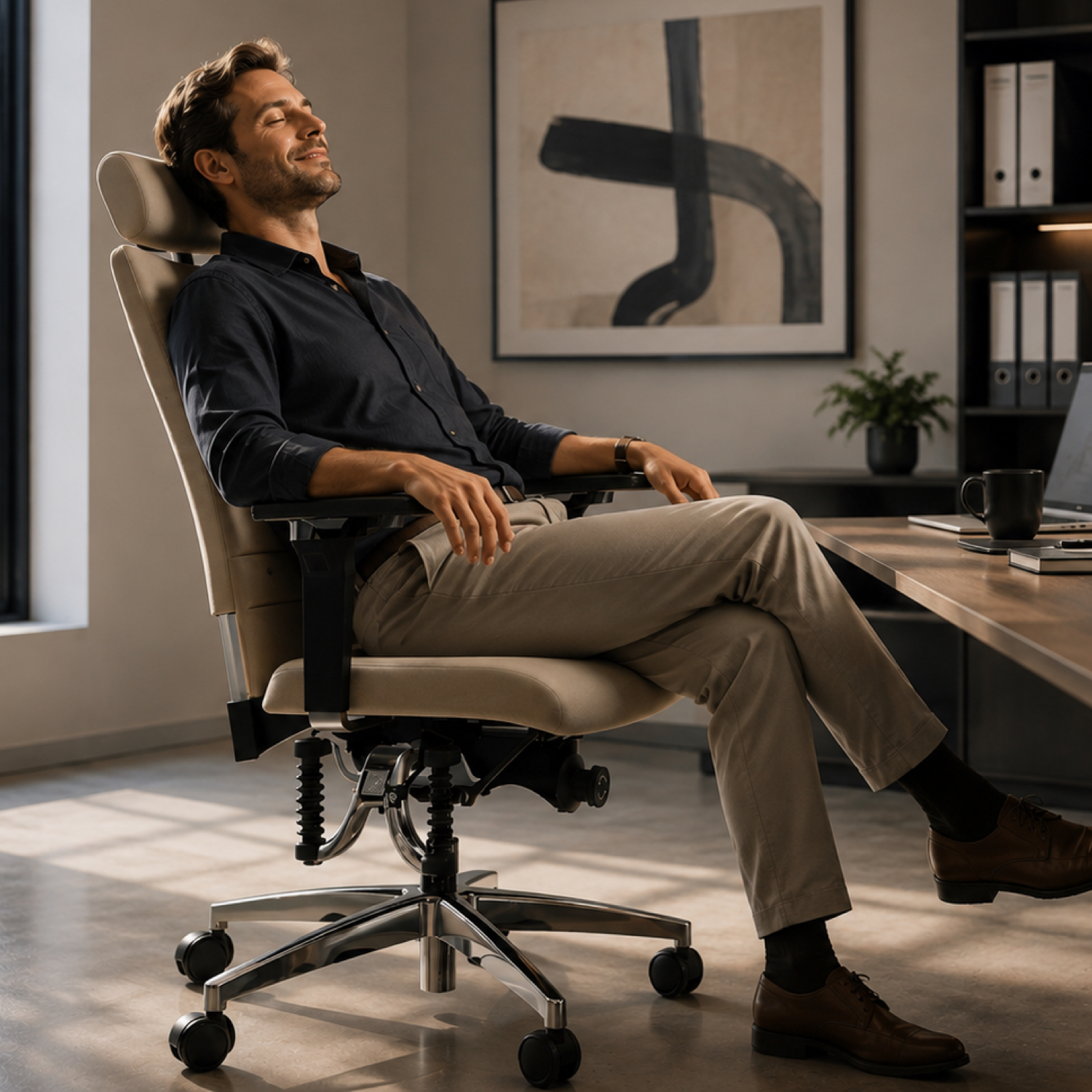
Why do we pay for an electric car seat but not an office chair?
The automotive industry has long understood the importance of sitting.
Cars are equipped with electrically adjustable seats, lumbar support, adjustable seat depth, memory functions, heating, ventilation and dozens of other features. All of this in an environment where many people may spend only one or two hours a day.
An office chair, meanwhile, may be used for eight hours.
Yet it sometimes seems perfectly normal for the main criteria when choosing one to be its price or whether it matches the colour scheme of the office. That is quite a strange contradiction.

Even the best chair cannot replace movement
There is one important point to make here.
No ergonomic office chair can automatically make eight consecutive hours of sitting healthy.
The human body needs movement.
Stand up. Walk. Stretch. Change your working position. When possible, take a phone call while standing or moving.
A good office chair should not replace movement.
A good office chair should support movement.
This is where modern ergonomic office chairs differ from the traditional idea that a chair should hold a person as firmly as possible in one “correct” position.
Put the price of an office chair into perspective
The price of a quality office chair may initially seem high.
But the same could be said about a good mattress, smartphone, television or optional equipment in a car.
The difference is the amount of time we use it.
If, for example, a €1,500 office chair is used for eight years and approximately 220 working days per year, it costs less than one euro per working day.
And thousands of hours may be spent sitting on that chair.
So instead of looking only at the price when buying an office chair, it may be worth asking:
• Does the chair suit my body and the way I work?
• Do its adjustment options allow me to find a position that works for me?
• Can I move naturally while sitting?
• Can the chair be adapted if my needs change?
• Are its construction and materials designed for long-term use?
These questions say much more about the true value of a chair than its price tag.

Maybe we simply need to think differently about the office chair
We do not consider investing in a good car strange.
We do not consider a quality mattress a luxury.
We understand why good shoes should support our feet and why work tools should suit the person using them.
The same logic could apply to the chair.
Because if you spend a large part of your working day sitting, an ergonomic office chair is not simply furniture.
It is the place where you work, think, communicate, make decisions and create. And perhaps an object on which we spend thousands of hours of our lives deserves a little more attention than we have given it so far.